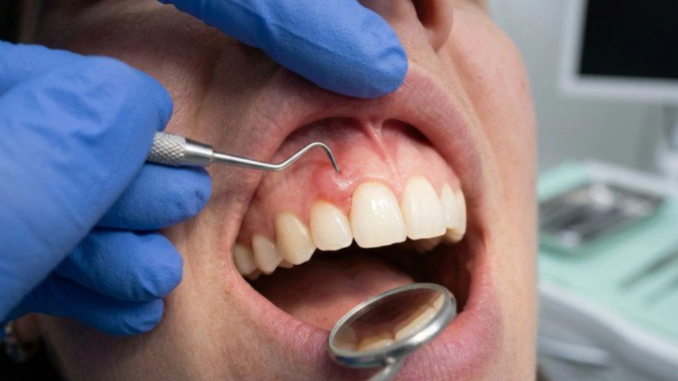
A 47-year-old man came to an oral surgery emergency unit in Riga, Latvia, with a swelling above his upper front tooth that had lingered for several weeks. It did not hurt, and he had no fever. He described only an unusual sensation in the area.
His dental history seemed to explain it. The tooth had an earlier root canal that clinicians judged inadequate, and an X-ray showed a dark area at the root tip, a classic sign of infection.
Then the surgical team opened the swelling to drain it. Working under magnification, they noticed something inside was moving.
They pulled out a live nematode, and laboratory analysis identified it as Dirofilaria, a genus of mosquito-borne roundworms best known as parasites of dogs. The case, from clinicians at Rīga Stradiņš University, was published in BMC Oral Health in March. The authors say no earlier case had documented the parasite inside a bone lesion at the root tip of a tooth with failed root canal treatment.
Every Clue Pointed to a Failed Root Canal
The swelling sat over tooth 11, the upper right central incisor in standard dental numbering. The tooth was not loose, the gum pockets around it were shallow, and tapping on it caused no pain. Pressing on the gum over the swelling, however, did produce a reaction.
Based on the history and X-ray, the treating endodontist diagnosed an acute apical abscess, a pocket of infection at the root tip that can form when bacteria survive earlier root canal treatment. Surgery to drain it was planned for the same day.
Nothing suggested a parasite until the incision. After removing the worm, the team cleaned out the lesion and prescribed antibiotics, since an ordinary dental infection had been the working diagnosis. Histopathology confirmed an adult dirofilarial worm. The report identifies the parasite only to the genus level, as Dirofilaria species, without naming a specific species.
Five days later, a cone-beam CT scan, a 3D dental imaging method, confirmed bone loss around the root tip consistent with apical periodontitis, inflammation that typically follows infection inside a tooth. The man then underwent endodontic retreatment, a second root canal procedure completed over two visits.
A Dog Parasite in the Wrong Host
Dirofilariasis is caused by parasitic roundworms spread through mosquito bites, and in dogs, one form is known as heartworm, according to the CDC. The main natural hosts are dogs and wild canids such as foxes and wolves. People are accidental hosts. Larvae from an infected mosquito can develop into adult worms in humans, but those worms remain sexually immature and produce no offspring, as the CDC’s life-cycle page explains.
The Latvian authors describe human dirofilariasis as typically a single-worm infection. They say oral cases reflect ordinary mosquito transmission followed by the worm wandering off course, not a special route involving the teeth. They also write that the parasite is not considered a cause of root-tip inflammation and most likely turned up by chance in an area that was already inflamed. In other words, there is no evidence that the old root canal attracted the worm.
The man told clinicians he had not traveled abroad recently but owned a dog. The report does not establish where or when he was bitten. Geography matters here, though. One study found that Dirofilaria repens emerged in Estonia, Latvia and Lithuania between 2008 and 2012 and became established within a decade, and the Latvian authors note a northward spread of these parasites in Europe.
Even by the standards of this rare infection, worms in the mouth are unusual. When Croatian clinicians reported a live worm in a patient’s lower lip in 2022, their PubMed search found only 24 published cases of D. repens involving the oral cavity worldwide. Such cases usually appear as nodules in or just beneath the soft lining of the mouth. The Latvian team says earlier oral cases involved soft tissue, with no documented involvement of bone or teeth.
What the Risk Looks Like in the United States
The species behind human cases varies by region. D. repens, the species most often reported in human cases in Europe, is not found in the United States, according to the CDC. In the U.S., the dog heartworm Dirofilaria immitis is the species most commonly reported in people, usually as small, round spots in the lungs that show up on chest X-rays. Most of those reported human infections have caused no symptoms.
Canine heartworm has been reported in every U.S. state, the CDC says. Both canine and human infections are most common in eastern and southeastern states, though rates are rising rapidly in a number of western states.
That broader picture is part of why the authors argue the case matters beyond Latvia. They write that oral dirofilariasis should be considered when a periapical lesion persists or fails to heal, particularly in areas where the parasite is endemic or emerging.
Full Recovery, with Limits on What One Case Can Show
At a follow-up visit six months after treatment, imaging showed the bone around the root tip had healed. The man later received a crown on the tooth.
The report describes a single patient, so it cannot show how often parasites hide inside lesions that look like routine dental infections. The authors’ central point is about diagnosis. A lesion that looks ordinary on X-rays can still contain something unexpected, and in this case surgical exploration and lab confirmation revealed it.
For patients, the practical takeaway is modest. Most persistent swellings near a treated tooth have ordinary dental causes, such as bacterial infection. Anyone with a swelling that does not go away should return to a dentist or endodontist. The CDC’s prevention advice for dirofilariasis centers on avoiding mosquito bites where infected mosquitoes may be present, including covering exposed skin and using insect repellent.
Key Questions Answered
What did surgeons find near the man’s tooth?
A live roundworm inside what looked like an infection at the root tip of his upper front tooth. Lab analysis identified it as a Dirofilaria species.
How do people get Dirofilaria worms?
Through bites from infected mosquitoes. Dogs and wild canids are the parasite’s main hosts, and humans are accidental hosts in whom the worms cannot reproduce.
Did the root canal cause the infection?
No evidence suggests that. The authors say the worm most likely ended up by chance in an area that was already inflamed after the failed root canal.
Is this a risk in the United States?
Human cases are rare. The species behind most European cases is not found in the U.S., though dog heartworm, which occasionally infects people, has been reported in every state.
What should someone with a lingering dental swelling do?
See a dentist or endodontist. Most such swellings have ordinary dental causes, and imaging plus, when needed, surgical exploration and lab testing can pin down the cause.
Leave a Reply