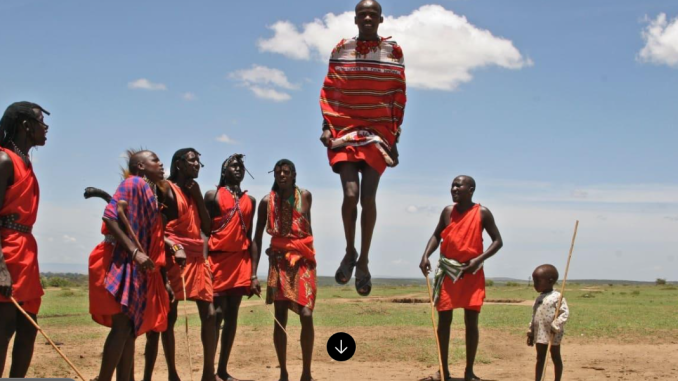
Imagine a group of men gathering in a circle, dressed in colourful red clothing, while one person jumps repeatedly into the air without using a running start. This is one of the most recognisable cultural performances associated with the Maasai people of Kenya and Tanzania.
The jump is part of a traditional dance commonly known as adumu, often called the Maasai jumping dance.
1. It is connected to traditional ceremonies
Adumu is associated with celebrations and gatherings, particularly those involving young Maasai men. It can be performed during important social occasions.
2. It demonstrates strength and stamina
Participants take turns jumping vertically while maintaining an upright posture. The performance requires balance, coordination and physical endurance.
3. It can attract attention
The height of a person’s jump may impress spectators and other participants. However, the dance is not simply a competition to find the strongest man.
4. Their clothing has cultural significance
Maasai people are widely recognised for wearing colourful shukas, often in red. Beaded jewellery and distinctive accessories also play important roles in cultural expression.
5. The Maasai have a strong community identity
Their traditions include pastoralism, cattle keeping, ceremonies and close community relationships. Cattle have historically held an important place in Maasai economic and cultural life.
Today, Maasai communities live in a changing world. Some maintain traditional lifestyles, while others work in modern professions, attend schools and live in towns.
The jumping dance is therefore more than an entertaining display. It is one visible part of a much broader cultural identity that has endured across generations.
Leave a Reply